Would use Baldwin's hand calculations to verify the basic strategy and later publish (in 1963) his famous book Beat the Dealer. Origin of the word blackjack.
Measurement of self-reported pain intensity in children and adolescents. Article is to (a) provide an overview of the measurement of pain intensity in children and youth, (b) outline the. Pain scale 31-Multiple Size Poker Chip Tool 32-Numerical Rating Scale Thermometer 33. Children under 4 years of age can often tell us that they are hurting. However, they usually cannot say how much pain they feel. Over 4 years of age, children can often say how they feel by using simple ways of measuring pain like the Poker Chip method. With the Poker Chip method, children are asked to say how many “pieces of hurt” they feel. Assessment of pediatric pain can be conducted in a number of ways including self-report, questionnaires and diaries, and behavioral observation measures. Most research in pediatric populations is on pain intensity, with few studies assessing other important domains or dimensions of pain (McGrath et al., 2008), such as location, sensory. Jul 25, 2010 Pain perception in children is complex, and is often difficult to assess. In addition, pain management in children is not always optimized in various healthcare settings, including emergency departments. A review of pain assessment scales that can be used in children across all ages, and a. In one large study, the Wong-Baker FACES scale was preferred by a majority of children. 9 Further- more, it was also the preferred assessment instru- ment of children 3 to 7, 8 to 12, and 13 to 18 years of age in another study by Keck et al. 1° Children 6 years of age and older can indicate the intensity of pain by using a visual analog scale.
The numeric scale are the Pain Thermometer or thePain Ladder. With both scales the higher numbers (like the higher rungs of a ladder) represent a greater degree of pain. Numeric scales have been shown to have a high degree of inter-rater reliability, validity and versatility. Poker Chip Tool (PCT): This tool uses 4 red poker chips to quantify. Multiple Size Poker Chip Tool. 4-year-old children:.64 (n = 54) 5- and 6-year-old children:.80 (n = 50) There was lower agreement between child self-report and parent pain ratings for 4-year-old relative to 5- and 6-year-old children using Hester Pieces of Hurt Tool and the Multiple Size Poker Chip Tool.
Behaviour ObservationalScales
CRIESis a useful tool for neonatal postoperative patients.It assesses Crying, Requirement of oxygen, Increase in vital signs, Expression,and Sleeplessness (Bildner, 1997).
FLACC is based on the observer’s assessment of the patientsFace, Legs, Activity, Cry and Consolability (Walker & Arnold, 2009).
Self-Reporting Scales
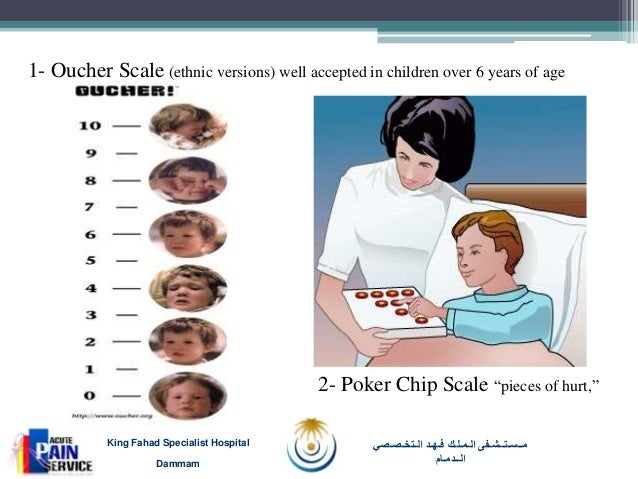
Children from 3 years of agehave the potential to reliably self-report pain using one of a number ofself-reporting pain assessment tools. These tools include the Faces pain scale– Revised, and the Wong-Baker faces pain rating scale. The Oucher scale usesphotographic images of children in differing stages of distress and a scale of0-10 alongside each picture. Younger children may find the poker chip scale usefulto quantify their pain whereas older children may be able to use the visualanalogue scale (Walker & Arnold, 2009).
Wong-Bakerfaces pain scale uses cartoon faces withdiffering expressions to indicate severity of pain from 0-10 (Walker & Arnold,2009).
The Faces pain scale has been revised from the initial sevenfaces to six with the first face representing no pain, of a 0/10 and the lastface representing 10/10. The revised faces pain scale differs from theWong-Baker faces as the ‘no pain’ face has a neutral expression instead of asmile and the most severe pain face does not have tears (Hicks, von Baeyer,Spafford, van Korlaar & Goodenough, 2001).
No Limit Texas Hold’em - you can bet all of your chips in no limit games, and the minimum raise amount is as much as the prior bet, or the current bets in the round. During these limit hold’em games a maximum of 4 bets are allowed per player per round. Texas holdem poker no limit online. You can raise your entire stack in these games.
The Oucherscale is unique in the fact that it is availableshowing a child of a different sex and race to allow the patient to relate tothe images more easily (Beyer, Villarruel & Denyes, 2009).
Poker Chip scale uses four ‘poker chips’ as ‘pieces of hurt’which the child uses to indicate how much pain they are feeling (Kohntopp,2011).
Visual Analogue Scale consists of a line usually 10cm longwith one end representing no pain and the other end representing severe pain.The patient indicates the level of pain experienced by indicating an area onthe line (Kohntopp, 2011).