- Best Texas Holdem Free Online
- Ultimate Texas Holdem Online Free
- Free Texas Holdem Against Computer
- Best Online Texas Holdem Poker
- Online Texas Holdem Real Money
- Texas Holdem For Money Online
- Best Online Texas Holdem Sites
Jul 25, 2019 A 150-Word History of Texas Hold’em. The birth of Texas Hold’em is officially credited to Robstown, Texas and dates back to the early 1900s.With four betting rounds and the majority of the cards face up on the table, Hold'em was much more “player friendly” than the other poker variations popular at that time. Away from the poker rooms, players can enjoy the excitement and intrigue of Hold’Em in online casinos and in the table games pits of live casinos. Ultimate Texas Hold’Em translates that Hold’Em experience to table games play against the dealer. Here are 10 things every beginner should know before playing Ultimate Texas Hold’Em.
Welcome to the Texas holdem poker section of our site. On this page we provide a complete guide to the game, how to play, the rules, and online versions. We also offer some observations about free games, strategy, and tips for winning. Throughout you’ll find links to other pages that cover specific subjects in greater detail.
We’re going to assume that the reader is a beginner and is starting from scratch. This doesn’t mean that there’s nothing in this section to help the intermediate or advanced player. If you already understand something we’ve covered here, just skip past it and move on to something you do need to understand.
Texas Holdem Hands and Hand Rankings
Texas Holdem Online
Texas Holdem Strategy
Texas Holdem Tips
Texas holdem is one of a number of poker games called “community” poker games. In a community poker game, each player receives a certain number of cards, and each player also shares several community cards which are dealt in the middle of the table. In this specific game, you get 2 cards face down, and 5 cards are spread out in the middle of the table.
You can use any combination of the 2 cards in your hand and the 5 cards on the board in order to create the best possible 5 card poker hand. Rounds of betting take place during certain parts of the deal, which happen in stages, and the player who hasn’t folded and has the best hand at the end wins the money in the pot.
Other community card games that are related to Texas holdem include Omaha, Omaha 8, Pineapple, and Crazy Pineapple. The main differences between Texas holdem and these other community card games is the number of cards dealt to each player-in Omaha you get 4 “hole cards”, and in Pineapple you get 3.
How to Play – The Rules for Playing Texas Holdem Poker
Now that you have a general idea of how the game works, we’ll cover the specific rules for playing in detail. Once you’ve read this section, you should have a pretty good idea of how to play Texas holdem. We also include a link to our incredibly detailed guide to how to play Texas holdem, as well as other detailed guides
How Betting Works – The Blinds
The first thing you need to understand about the game is how the betting works. In most other varieties of poker, every player has to place a mandatory bet called an “ante”. They place this bet every hand, and this forced bet is what drives the action. Without a forced bet, players could just wait until they had a perfect hand before entering a pot. That would make for a boring poker game.
You’ll occasionally run into a Texas holdem game which uses an ante, but most of them don’t. All Texas holdem games (even those with an ante) use a “blinds” system. A blind is a forced bet, just like an ante, but it’s a rotating bet. You only have to place a blind bet when it’s your turn; the blinds rotate around the table.
There are 2 blinds in Texas holdem-the small blind and the big blind. These are pre-determined by the stakes of the game. In general, the small blind is half the size of the big blind. In a home poker game, the blinds are posted by the 2 players to the left of the dealer. In a casino cardroom, where there’s a professional dealer, a dealer button rotates around the table so that the players know who has to post the blind. In a heads-up situation, the player with the dealer button places the small blind, and the other player places the big blind.
How Betting Works II – Betting Limits
Texas holdem can be played in one of 3 varieties based on the betting rules:
- Limit holdem
- Pot limit holdem
- No limit holdem
In limit holdem, the sizes of the bets are pre-determined, and you can’t bet more than those sizes.
ExampleYou’re playing in a $3/$6 limit holdem game. During the first 2 rounds of the hand, your bets must be in increments of $3. You can bet $3 or you can raise $3. During the final 2 rounds of the hand, your bets must be in increments of $6. You can bet $6 or you can raise $6.
In pot limit holdem, the sizes of the bets are limited by the amount of money in the pot. You cannot bet or raise more than the size of the pot.
You’re playing in a pot limit game with $2/$5 blinds. There’s $7 in the pot, so the most you can bet or raise when it’s your turn is $7. Once someone has bet $7 into the pot, there’s now $14 in the pot, so you can raise that amount. Pots can grow in size very quickly in pot limit holdem, which changes the strategy in multiple ways.
In no limit holdem, you can bet as many chips as you want to, as long as you have the money in front of you.
You’re playing in a no limit holdem game with $2/$5 blinds. There’s $7 in the pot, and you have $93 in chips in front of you. You can raise up to $93 if you want to, but no more.
One common misconception that’s used as a plot point in television and film is when a poker player has to risk his house or something in order to cover the size of a bet someone else made at the table. This never happens in real life. In an actual poker game, you never have to bet more money than you have in front of you, but the other player only has to risk that amount, too.
You raise the pot to $93, but the player who acts after you only has $50 in front of him. He can still call your bet, but you’ll only risk $50 against that player. The money is put into a side pot.
How Betting Works III – The Deal and Betting Rounds
The last piece of the betting puzzle is based on the way the deal is handled. Here’s how that works:
The 2 players to the left of the dealer post the blinds. Then the dealer deals everyone their 2 hole cards.
Once everyone has their hole cards, there’s a round of betting. You can call the big blind to get into the hand, or you can fold. If you call, you have to put a bet of the appropriate size into the pot. If you fold, you don’t have to put any money into the pot, but you don’t get any additional cards, and you don’t have a chance of winning at the showdown. If you really like your hand, you can raise, which means you put the amount of the bet into the pot along with an additional amount. The player who bet previously has to put more money into the pot in order to stay in the hand.
After this betting action, the dealer deals 3 cards into the center of the table. These 3 cards are called the flop. After the flop, there’s another round of betting. The only players who can participate at this point are the ones who didn’t fold before the flop.
Then the dealer deals another face up card-the turn. After the turn, there’s another round of betting.
Finally, the dealer deals one more face up card-the river. After the river, there’s a final round of betting.
After all the rounds of betting, all the players who are still in the pot turn over their hole cards. The player with the best hand, composed of the cards in their hand and on the board, wins the money in the pot.
In limit games, the numbers refer to the size of the bets during the first 2 rounds and during the 2nd 2 rounds.
ExampleYou’re playing in a $4/$8 limit holdem game. The blinds are $2 for the small blind and $4 for the large blind. After the hole cards and after the flop, the bets are made in $4 increments. After the turn and after the river, the bets are made in $8 increments.
For more information on betting strategies, you can refer to any of our in-depth beginner guides:
- Texas Holdem Books
Texas Holdem Hands and Hand Rankings
Texas holdem is rarely dealt with wild cards. (A wild card is a card that can be used to “stand in” for a card you need to make a better hand.) You’ll sometimes find wild cards in use during home poker games, but not in casino cardrooms. But most of the time, there are no wild cards in Texas holdem.
As a result, the standard rankings of poker hands apply. We’ve listed them below from best to worst possible hand. The rankings are based on how unlikely it is to receive a particular hand:
- Straight flush
- 4 of a kind
- Full house
- Flush
- Straight
- 3 of a kind
- 2 pair
- 1 pair
- High card
A straight flush is a hand where all the cards are of the same suit and are in consecutive order. For example, a 10JQKA, all of spades, is a straight flush. (And in this example, it’s a royal flush, because it’s the highest possible straight flush you can get.) In the event of a tie, the straight flush with the highest card wins.
A 4 of a kind is a hand where 4 of the 5 cards are of the same ranking. An example of a hand with a 4 of a kind might have 2222A. That would be the 2 in every suit–clubs, diamonds, hearts, and spades. In the event of a tie, the 4 of a kind with the highest hand ranking wins.
A full house is a hand that consists of 3 cards of one rank and 2 cards of another rank. An example of a full house might look like this: 555KK. In the event of a tie, the hand with the higher cards in the 3 cards is the winner.
A flush is a hand that consists of 5 cards of the same suit-clubs, diamonds, hearts, or spades. In the event of a tie, the flush with the highest card is the winner.
A straight is a hand where all 5 cards of consecutive ranks. A2345 is an example of a straight. In the event of a tie, the straight with the highest card is the winner.
A 3 of a kind is a hand where 3 of the cards are of the same rank, but the other 2 cards are of a different rank. In the event of a tie, the hand with the higher ranked cards wins. An example of a 3 of a kind would be KKK27.
2 pairs is a hand where you have 2 cards of one rank and 2 cards of another rank along with a final card of another rank. An example of 2 pairs might look like this: AAKK7.In the event of a tie, the hand with the highest pair wins.
1 pair is a hand where you 2 cards of one rank and 3 cards with different ranks. An example of a pair might look like this: JJ278. In the event of a tie, the higher ranked pair wins.
High card means a hand where none of the other hand rankings apply. If no one still in the hand can make a pair or better, the player with the highest card in his hand wins the pot.
There’s one more concept you need to understand about hand rankings-kickers. A kicker is a card that breaks a tie.
ExampleYou have a pair of kings. Your opponent also has a pair of kings. Normally if both players had a pair, the higher-ranked pair wins, but in this case, there is no higher ranked pair. So the players compare the single cards in their hand to see which of those is higher. If you have an ace kicker and he has a queen kicker, you win.
We got into more detail about poker hand rankings on those specific pages of our site.
Texas Holdem Online
With the growth of the Internet, Texas holdem online has become a thing. Since this site is in English, we have a lot of readers from the United States, so our coverage of online Texas holdem is going to slant slightly toward the US market. But players all over the world play Texas holdem on the Internet.
Differences Between Land Based and Online Texas Holdem
The differences between the game as it’s played online and as it’s played in traditional land-based cardrooms are slight. Of course, one game is played on a computer, so you’re not face to face with the other players, but that difference is more minor than you might think. A lot of the differences have to do with practical matters like buying in and placing bets.
In a traditional cardroom, you exchange cash for chips, and you play poker with the clay chips at the table. In an online cardroom, you have to deposit money into an account with the cardroom first. Once you’ve done this, you can use that money to buy into the various games on the site.
Multiple deposit methods are available at online cardrooms, here we list a few:
Option #1Most people just use a credit card to fund their account, but you can also get money to an online poker site using a wire transfer or a service like Western Union or Moneygram. Some credit card issuers decline any transaction that’s flagged with an online gambling code as a matter of policy, especially if you’re from the United States, so other deposit methods become necessary.
Option #2Another option for making a deposit at an online poker room is to use an online wallet of some sort-preferably one that specializes in online gambling. In countries where online poker is legal and regulated, you can use the original online wallet-PayPal. But in countries like the United States, where poker is in a murky legal area, you might have to use an online wallet that specializes in such transactions. Even some of these wallets restrict transfers from U.S. players.
Option #3Another option for funding online gambling accounts that’s growing in popularity is BitCoin. If you’re not familiar with it, BitCoin is a peer-to-peer financial instrument. You can consider it to be something like privately-issued digital money. To use BitCoin for an online gambling transaction, you need to have some kind of BitCoin wallet service.
Another difference between land-based and online Texas holdem is the availability of the games. Of course, traditional cardrooms, whether they’re hosted by a casino or whether they’re a free-standing cardroom, accept any players who walk in the door-provided they’re of age and can afford the buy-in.
But online cardrooms have restrictions related to your country of origin. In fact, most online cardrooms don’t accept players from the United States at all any more. A hand full of rooms still do, but most poker sites are worried about legal action. If you’re from the USA, you should consult our site for recommended places to play. In the absence of significant legal oversight, an online cardroom’s reputation is more important than ever.
How the game plays is subtly different online, too. For one thing, you’re not able to see your opponents at all. This eliminates some of the reading of other players that’s often a big piece of a professional’s strategy.
Other tells exist, though. Online players can analyze another player’s screen name, his behavior in the chat box, and his betting behavior in order to get at least a general idea of his opponents’ tendencies. Some data-mining software can be used to separate which players win consistently from those who lose consistently. Many of the more reputable cardrooms disallow the use of this kind of software as it’s contrary to the spirit of the game.
Another major difference is the rate at which you’re able to play. In a traditional cardroom, dealers are fast, but they’ll never be as fast as a computer. You’ll see at least twice as many hands per hour playing online.
Game variety is a big plus on the Internet side of things. In a casino cardroom with only a dozen or so tables, the games and limits available can be limited. But with a nearly infinite number of tables in a virtual setting, an online cardroom can offer an almost unlimited variety. The only real limitation is based on whether or not other players at the site want to play your game at your stakes.
Other differences exist, but those are the biggest.
Free Texas Holdem Poker Games
We left out one big difference between Internet Texas holdem and traditional brick and mortar games. In a land-based casino, you’d never find a poker game being played without real money on the line. The house makes its money by taking a percentage of each pot (the “rake”), so they have no incentive to offer free games.
But in the world of online Texas holdem, free games are not only common-they’re ubiquitous. These are great opportunities for players to learn how the game works, especially in terms of the control interface. All online cardrooms have subtly different buttons for calling, checking, folding, and raising. It’s a good idea to spend some time at the free tables getting used to the interface. After all, it would be a shame to accidentally raise if you have a 27offsuit preflop (which is the worst possible preflop hand). It would be an even greater shame to accidentally fold if you have AA preflop (which is the best possible preflop hand.)
Some sites and apps specialize in offering nothing but free Texas holdem games, but for the most part, the free games are marketing tools for the real money versions of each site. In some cases, the free-only sites work on a points system, and sometimes these points can be traded for prizes.
If you want to play Texas Holdem for free, check out our Texas Holdem game page:
Texas Holdem Strategy
Unless you’ve had your head buried in the sand over the last decade or two, you probably already know that poker-even Texas holdem-is a game of skill. Lucky might play a larger factor in Texas holdem than in other games, but the skill element is undeniable. This means that smart players want to learn something about Texas holdem strategy.
We offer an entire section of articles about Texas holdem strategy that you should visit, but we introduce a few key concepts below:
Approach Is Important
Your approach to the game can be looked at in a couple of different ways. One of those looks at how often you decide to play in a hand-this is a measure of how tight or loose you are. The other looks at how often you decide to bet and raise as opposed to calling and checking-this is a measure of how passive or aggressive you are.
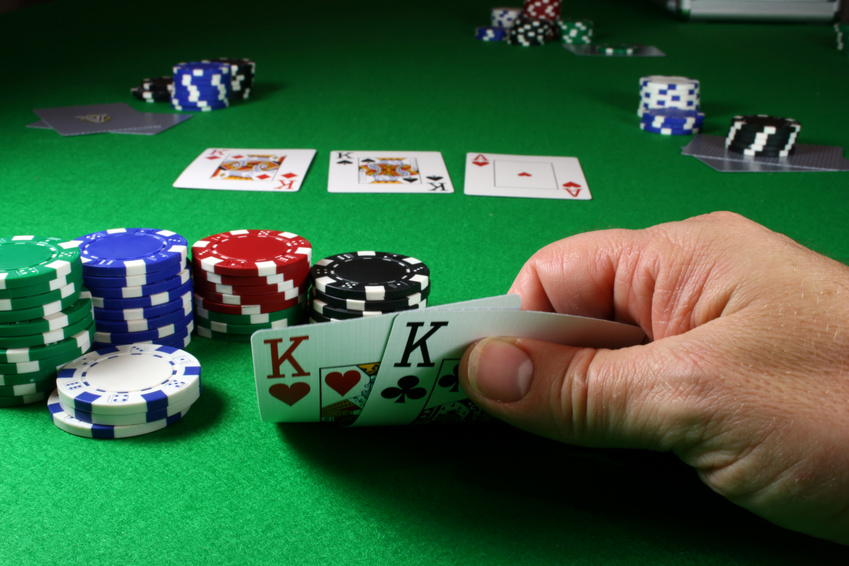
In fact, you can categorize most players into one of 4 categories:
- Tight Aggressive
- Tight Passive
- Loose Aggressive
- Loose Passive
A tight player is a player who doesn’t play many hands. He folds most hands and only stays in a hand if his cards are good enough to have a better than average chance of winning.
A loose player is the opposite. He plays more hands than average, hoping to improve his holdings during the later rounds of betting.
Of the two approaches, tight is usually better, especially for beginners. You can remember a simple rhyme that makes a nice mantra to remember how you should play:
“Tight is right”.
Aggressive PlayerAn aggressive player is a player who tends to bet or raise. He rarely checks or calls, preferring to put more into the pot almost every time he acts. Betting and raising have advantages over checking and calling, because when you bet and raise, you create a situation where your opponent or opponents might fold. If you check or call, you’ve created no incentive for them to not stay in the hand and possibly draw out on you.
Passive PlayerA passive player, on the other hand, is more likely to just check or call when it’s his turn to act. This eliminates the possibility of running the other players out of the hand and winning a hand without a showdown.
Most experts agree that a tight aggressive approach is the best way to play. You don’t play a lot of hands, so when you do get into a hand, you have a better than average chance of winning the pot at a showdown. Other players will also notice that you’re not playing a lot of hands, so they’ll be more likely to respect your bets and raises.
Also, when you do get into a hand, you’re doing 2 things by being aggressive. You’re getting more money into the pot with better than average hands, which increases the amount of money you’re likely to win at a showdown. But you’re also increasing the percentage chance you have of winning. If you’ve increased the chance of everyone else folding by a few percentage points, you’ve made a big change to the expected value of your bets.
A loose aggressive player is often called a maniac. This can be an effective approach if you have a certain degree of skill, because a maniac will often pick up a lot of small pots just by bullying the other players out of hands. Some pros use this style consistently to good effect.
A tight passive player is often called a rock. This player might break even but is more likely to lose. He lets too many opponents play speculative hands without paying for them, and so they often draw out on him. This is a better approach than being a loose passive player, but not by much.
A loose passive player is often called a calling station. This is the player at the table who keeps calling bets to keep the raisers honest. He rarely makes any raises, but he’ll chase a hand down to the river more often than not. This is the best kind of opponent to face, but it’s also the worst kind of player to be.
Bluffing and Semi-Bluffing
We have an entire page about bluffing where we go into detail, but here’s what you need to know about bluffing and semi-bluffing in Texas holdem, in broad strokes:
Bluffing is when you bet or raise with a hand that’s probably not the best hand in play. Your goal when bluffing is to get your oppo13.25nent or opponents to fold so that you can win the pot without a showdown.
A semi-bluff is similar to a bluff, but it’s done with a drawing hand. You don’t have the best hand, but you still have an opportunity to draw to a better hand during the later parts of the deal.
Bluffing isn’t something you should never do, but it’s also not something you should always do. If you never bluff, your opponents will always fold when you bet and raise, which means you won’t get any action and won’t as much money as you could. If you always bluff, you’ll get called down a lot and lose a lot of money.
In fact, one of the concepts that most people don’t think about when it comes to bluffing relates to position and the number of opponents you’re facing. You should only bluff from late position, which means you’re acting AFTER most of the other players at the table. If you’re the first player to act, and all 7 of the players behind you call your bet, you’re in trouble.
Also, you should probably only bluff when you’re facing one or two opponents. The more opponents you’re trying to bluff, the harder it is to succeed.
ExampleYou’re trying to bluff 4 players. Each of them has a 50% chance of folding in the face of a raise.
But what you’re concerned about is whether or not ALL of them will fold. To determine the probability of that, you multiply the odds that each of them will fold:
Unless the size of your bet is very small, a 6.25% chance of winning doesn’t warrant bluffing.
Semi-bluffing often makes more sense, because you now have the opportunity to win the pot in two ways. If everyone folds, you win the pot by default without even having to show your hand.
But if you draw out on your opponent, you can win at the showdown.
You have 4 cards to a flush-2 in your hand 2 on the flop. You THINK your opponent has a high pair. Right now, you have the worse of the 2 hands.
But you raise.
He might fold, thinking you have 3 of a kind or 2 pairs.
But even if he calls, you have a roughly 1in 3 shot at drawing to a flush on the turn or the river. If you hit your flush, you’ll win, unless he draws to a better hand, too.
Bluffing is an overrated part of the game, mostly because of television and movies.
Position Is Incredibly Important
When you act in a game of Texas holdem is incredibly important. Poker strategy writers refer to this as “position”. Based on where you are in relation to the blinds, you get to see what the players who act before you do.
ExampleYou have a pair of 7s. You’re playing with some reasonably tight opponents. You’re the first person to act, so you call the blind. The player behind you raises. The player behind him re-raises. And the player behind him re-raises the first two players.
When it gets back to you, the choice is clear-you have to fold. The odds of one of those 3 players having you completely dominated are excellent.
You have a pair of 7s. You’re the last person to act. Three players ahead of you are “jamming the pot”, i.e. betting and raising aggressively. When it’s your turn, you fold-but you saved a bet, because you didn’t enter the pot in the first place.
Here’s the rule of thumb about position:
You need a much stronger hand to enter a pot in early position than you do in late position.
The actions of the other players matter, but they matter less than being able to see what they’re going to do.
More money is lost at the holdem tables because of players’ refusal to take position into account than for any other reason.
Starting Hand Requirements
The 2 cards in your hand are your hole cards. These are also called your starting hand. Smart players have certain requirements that their starting hands have to fulfill before they’re willing to play them. The best players’ starting hand requirements are integrated with position.
Pairs are always legitimate starting hands, but bigger pairs are better. If you’re in early position, you might not even play small pairs at all. It depends on the texture of the table and your tolerance for risk.
Big suited cards are also legitimate starting hands a lot of the time. They give you the opportunity to make a flush and also to make big pairs on the flop or on later rounds. These hands are better if they include an ace or a kind.
Suited connectors are cards with the potential to make either a flush or a straight. The 7 and the 8 of hearts is an example of a starting hand that would be considered suited connectors. As a rule of thumb, the higher the ranks of the cards and the fewer gaps between them, the better.
The earlier your position, the stronger your hand needs to be in order to play it. Big pairs, especially aces and kings, are almost always playable from any position. AK suited is also almost always playable, and AQ suited is often playable.
If you’re playing something from the more speculative groups, you really need to hope to improve your hand on the flop in order to stay in the hand. For example, if you have a pair of 2s as your starting hand, you really need to hit another 2 on the flop to stay in the hand.
You should probably only be playing the best 15% to 20% of the hands preflop, which means you’ll be folding pretty often. And even on the hands in which you stay, you’ll probably fold 50% of those when you see the flop. This line of thinking is called “fit or fold”.
A lot of Texas holdem strategy involves just being patient and waiting to get the cards. Then you bet the cards.
Texas Holdem Tips
We also have an entire page of Texas holdem tips for you to peruse, but here are some quick, broad-overview type tips for you to think about:
- Bet or raise instead of checking and calling.
Passive play is losing play in Texas holdem. The easiest way to avoid being passive is to bet and raise instead of checking and calling. We know successful players who never cold call at all-they believe they should either raise or fold.
- Be selective about the hands you play.
This is arguably less important than being aggressive, but for new players, it’s pretty important. Some loose players do well if they’re really aggressive, especially if they’re playing against some passive players. But the most consistently profitable strategy for newer players is to be tight and aggressive.
- Pay attention to position.
Most Texas holdem players don’t pay nearly enough to their position when deciding which hands to play and how to play them. The rule of thumb is simple enough-have more stringent requirements from your hands in early position.
- Bluff carefully if at all.
We’re big fans of the semi-bluff. If you are going to bluff, do it when you’re in late position and when you only have one or two opponents. The odds of successfully bluffing 3+ players go way down, unless you’re playing with extremely tight players.
- If you’re going to play online, try the free games first.
That way you’ll learn how the controls work and avoid any potentially costly mistakes based on silly user-errors that could have easily been prevented.
For more tips, be sure to check out our Texas Holdem Tips page:
Texas Holdem Quizzes
One of the best ways to see if you’re as much of an expert at Texas holdem as
you think is to take quizzes. Even if you disagree with the answers and
approaches we have to the game, you’ll benefit from thinking critically about
the game.
When you’re reading through these Texas holdem quizzes on our site, don’t
just read them. Take the time to write your answers to the question. Include, in
writing, the reasoning behind your answers.
Start with the quiz that applies to the type of game you play most often,
cash games or tournaments. The other basic quizzes are important to read through
early, too-position and starting hands are critical skills to master in the
beginning stages.
We also have quizzes about more intermediate and advanced topics, too.
Beginners probably shouldn’t worry much about tells or bluffing. Everyone needs
to know how to play a hand on the river, though, but you still need to
understand starting hand requirements first.
Conclusion
Texas holdem is a great game, and we’re really proud of the resources we’ve included in this section. Our goal with this page and with all the pages we link to from here is provide the most comprehensive guide to the game that you’ll find.
This is a long page and covers a lot of information, but much of it is aimed at beginners. The other pages in this section are of a wider variety-some are appropriate for beginners, but other pages and concepts are probably more suited for intermediate or advanced players.
The ability to play online Texas holdem from your house or
apartment or on your tablet or phone while you’re on the go is
one of the best developments of the last 20 years. No longer do
you have to get dressed and drive or fly to the nearest casino
with a poker room or risk the dangers of playing at an
underground game.
Now you can find thousands of players competing online at any
hour of the day. The largest online poker rooms have tens of
thousands of players around the clock and dozens of online rooms
have over 1,000 Texas holdem players waiting for you to join the
action at any time of the day or night.
But before you jump into the fray take a few minutes to learn
more about playing online including about online poker room
bonuses, deposit and withdrawal options, playing styles, limits,
and a few things about strategy.
Limit and No Limit
Deposits & Withdrawals
Playing Styles
Additional Resources
Free Games and Freerolls
At the low end of online Texas holdem play are free ring game
tables and free tournaments. These games don’t cost anything to
play and you can’t win real money. The competition is terrible
and even if you play perfect strategy the variance can be
brutal. You’ll win eventually if you keep playing solid poker,
but you’ll also get drawn out on often.
The next step up is freeroll tournaments. These are almost
always run as no limit Texas holdem games. You get to play for
free but the top finishers win real money. Most players who
finish in the money win pennies and even the final table
finishers usually only win a couple dollars. But what can you
expect?
Freeroll tournaments are also filled with poor players, but
you will find a few decent players at most tables. You need to
play a tight and aggressive tournament strategy, but don’t be
surprised if you get knocked out by a player who plays an odd
hand or should fold instead of calling.
You can play in freeroll tournaments until you win enough
money to start playing at the micro limits and keep improving
and building your bankroll from there.
Real Money Stakes
Micro Limits
Once you master the free games or if you want to jump in at
the lowest levels of real money online Texas holdem play you can
play at the micro limit tables. These tables start with limits
as low as .01 / .02 at some poker rooms and the no limit games
can be entered with $1 or less.
Surprisingly, the play is much better at the micro limits
than at the free tables, but the overall level of your
competition is still quite poor.
Low Limits
The low limits are where most players start feeling like
they’re playing for real money, but you can still play at these
limits with a deposit of $100 to $200. Even if you’re a
consistent winner it’s difficult to make a living at this level.
Your best bet to win consistently is to play a solid game
focusing on tight starting hand requirements, correct calls and
folds base on pot odds, and not trying anything fancy. Simply
[lay your best poker, bet when you have the best hand, and fold
when you don’t. Most bluffs are a waste of time and trying to
fool your opponents isn’t worth trying because they probably
aren’t paying attention anyway.
Medium Limits
At the medium limits of online Texas holdem, you start
separating the real players from the pretend players. If you’re
able to win consistently at this level you can make a decent
living as an online poker player.
You have to be a good fundamental Texas holdem player but you
also have to be able to read your opponent’s betting patterns,
adjust your play based on the table, and think beyond the
current situation. You need to start visualizing all of the
possible outcomes for every hand and use this information to
make every single decision.
High Limits
When you start playing online Texas holdem at the high limits
you’re playing with a great deal of money. Pots can reach
hundreds of thousands of dollars and frequently reach into the
tens of thousands.
The competition is good, with professional poker players
joining these tables often. Not only do you have to be a top of
the line player from a poker basics standpoint, you also have to
be able to play the other players and constantly adjust your
game if you want to be a long term winner.
Another issue that can become a concern when you play at
these limits is moving your money around online. The best option
is usually direct bank wires into and out of the poker room, but
when you’re moving tens of thousands of dollars and more it can
create issues that low level players don’t have to think about
and deal with.
Limit and No Limit
Most players are introduced to Texas holdem by watching a no
limit game. Most televised poker games and tournaments are no
limit Texas holdem. When you start playing online you’ll have
plenty of no limit options.
But online poker rooms also offer limit Texas holdem games
and many players would be better off starting in these games
instead of jumping into the no limit games. You still have to
play solid poker to win at the limit tables, but a mistake
rarely costs you your entire stack like it does at the no limit
bales.
If you’re a new player or are just starting to play
online, consider trying your hand at a few low level limit
tables before moving up and / or to the no limit tables.
Online Strategy
Online Texas holdem strategy is the same as live game
strategy. The only real difference is you can’t see your
opponents so if your game depends a great deal on reading your
opponents you’ll need to make a few adjustments moving from live
play to online games.
We have an entire section of the site dedicated to Texas
holdem strategy, so if you want to get a complete education you
should investigate that. But here’s an overview of the important
parts of online Texas holdem poker strategy you need to focus on
in order to be a winning player.
Best Texas Holdem Free Online
The importance of playing better
starting hands on average than your opponents will never change.
If you want to be a winning Texas holdem player you have to use
smart and tight starting hand requirements. The good news is
most of your online opponents play far too many hands so this
makes your job easier.
Position is directly related to your choice of
starting hands. Only play your strongest hands when you’ll be
out of position and you’ll get better results. Most players
ignore position so if you simply use good judgment you’ll be
ahead of most Texas holdem players in this area.
Don’t be like most online Texas holdem
players and simply jump into the first game you see. Take some
time to watch a few tables and find one that seems to be filled
with poor players. Choose to play against worse competition, not
better, and your results will instantly improve.
This is especially true when you consider they are offering the same banking options you would expect to find while playing at the desktop version of the online poker room. Free real money poker app. Banking Options and Customer SupportAndroid poker apps have come a long way to provide the best online poker experience in the palm of your hands. You will also be able to accumulate loyalty points while playing through your Android poker app and Refer a Friend to the online poker site directly on the app. Most of the Android poker sites will allow you to make a deposit directly through the app as well as request a withdrawal for your latest winnings.
BluffingUntil you reach the middle and high limits you’re
probably best to not bluff at all. You might be able to run a
successful bluff from time to time at the low limits, but most
of your opponents simply aren’t very good so they won’t even
realize they should fold or call, depending on what you’re
trying t accomplish, so your bluff will be wasted.
You can’t see your opponents
when you play online but you can notice certain playing
tendencies they have. Some players become predictable in certain
playing situations and if you pay enough attention to learn
about these situations you can use the information to increase
your profits.
It may seem strange to see a section on
bankroll management in a set of things about strategy, but the
best Texas holdem players follow bankroll guidelines and f you
want to be the best you need to start acting like he best. Make
sure your bankroll is big enough to support your play at your
current levels.
Playing Styles
When you play Texas holdem the way you play your hands can be
classified as one of four different playing styles. It’s
important to understand your playing style and be able to place
your online opponents in one of the four categories as well.
When you can determine which playing style each of your
online opponents uses you can use this information to make
better playing decisions against them. Here are the four playing
styles.
- Tight and Aggressive
When you play tight and
aggressive it means you don’t play many starting hands and
when you play a hand it’s usually played in an aggressive
manner. This means you bet and raise trying to force your
opponents to make mistakes. You rarely check and call
because you can’t get your opponents to fold when you play
passively. Tight aggressive play is generally determined to
be the most profitable way to play. - Loose and Aggressive
A loose an aggressive player
plays their hands aggressively like the tight and aggressive
player, but the loose player plays far more hands. A loose
aggressive player can be profitable in the long run if they
play well after the flop, but they have more to overcome to
reach profitability than the tight aggressive player because
they start too many hands behind their opponents. - Tight and Passive
A passive player rarely bets or
raises, choosing to check and call in most situations. This
style doesn’t force your opponents to make mistakes and
forces you to show down the best hand because your opponent
doesn’t have an opportunity to fold. Because of the tight
starting hand requirements a tight and passive poker player
can play close to break-even poker in many games, but it’s
difficult to be a long term winner playing this way. - Loose and Passive
A loose player who also plays
passively has almost no chance of winning in the short or
long term. They play too many hands and then let their
opponents lead the action.
You want to play in a tight and aggressive manner as much as
possible if you want to win the most in the long run. In some
games you can loosen up your starting hand requirements slightly
but you want to keep playing aggressively as often as possible.
When you’re able to place your online opponents into one of
these categories you can use this information against them. If
you know a player is aggressive you can check to them with a big
hand sometimes because the odds are strong that they’ll bet. If
a player is passive you can draw to hands more often because
they won’t make you pay a high price to do so.
Ultimate Texas Holdem Online Free
Bonuses
When you start playing poker online for real money you can
usually get an attractive sign up bonus. These usually offer a
set percentage of your deposit up to a certain amount.
Here are a couple examples.
- 100% deposit bonus up to $100
- 200% deposit bonus up to $500
If you get a 100% bonus up to $100 it means the poker room
matches your deposit up to $100. If you deposit $25 the poker
room matches it with $25. If you deposit $100 they match it with
$100.
If you get 200% on a $100 deposit you get an extra $200.
Most online Texas holdem bonuses are placed in a special part
of your account and released in small increments based on how
many raked hands you play or how many poker or comp points you
earn. You might have $10 of your bonus account released for
every 500 raked hands you play or every 100 comp points you
earn.
The only way to know exactly what you’re signing up for and
what you have to do to clear the bonus is read the terms and
conditions closely. If you don’t completely understand how a
bonus works you can contact the support department of the poker
room. It’s always better to find out about bonuses before making
a deposit.
Deposits and Withdrawals
If you’re going to play online Texas holdem you have to be
able to move your money into and out of the poker rooms. Your
ability to do this easily is directly related to where you live.
For example, if you live in the UK you have a wide range of
online wallet accounts and other deposit and cash out options.
But if you live in the US you might need to use a credit card or
direct bank wire to make a deposit and accept a check in the
mail to make a withdrawal.
Here’s a list of popular deposit and withdrawal methods for
online Texas holdem.
- Bank Wire Transfer
- Visa/MasterCard
- Neteller
- Skrill
- Western Union
- PayPal
- Check
- ACH
Free Texas Holdem Against Computer
The easiest way to see which options you have is to look in
the cashier area of the poker room where you play or contact the
customer support department.
Bankroll
When you play online Texas holdem you have to use the same
type of bankroll management as you do playing live poker. If you
don’t have enough bankroll to ride out the ups and down of
playing poker you stand the chance of running out of money. If
you can’t buy into a game you can’t possibly profit from the
game.
Best Online Texas Holdem Poker
Here are some general online Texas holdem bankroll
guidelines. They aren’t exact because they don’t take into
account your ability. If you’re a losing player you’ll never
have a big enough bankroll.
Online Texas Holdem Real Money
No Limit Ring Games
When you play no limit Texas holdem ring games you should
keep from 20 to 30 times the average buy in amount of the games
you play. If you play $500 buy in no limit games you should have
between a $10,000 and $15,000 bankroll.
Limit Ring Games
Limit players should have 200 to 300 big blinds for the limit
they play. If you play $20 / $40 limit you should have $8,000 to
$12,000 in your bankroll.
No Limit Tournaments
If you play no limit Texas holdem tournaments your bankroll
requirements are tied more closely to how often you can manage
to finish in the money and how often you’re able to make a final
table with the chance to win a large prize pool.
When you win a large tournament you might win anywhere from
100 to 500 times your buy in, so this can have a large impact on
your bankroll.
A good rule of thumb is to start with 25 times the average
buy in of the large player pool Texas holdem tournaments you
play in. As you play you can see how often you can get into the
money and how often you need to do so to break even.
Some of the top players only need four or five times the buy
in as a bankroll, but even most of them have 50 to 100 times the
buy in or more.
The biggest job of your bankroll other than buying into games
is to give you enough of a mental cushion that you don’t have to
think about the playing decisions made on every hand in relation
to your bankroll.
Texas Holdem For Money Online
In other words, you want a bankroll big enough you never have
to think about it while you’re playing.
Additional Resources
In addition to all of the information above, we have provided you
with a few other articles we think you my find useful for playing
online poker.
Best Online Texas Holdem Sites
- Texas Holdem Calculators
Summary
Playing Texas holdem online is a great way to unwind or
compete in an exciting game from the comfort of your home. You
don’t have to waste the time and energy to travel to the nearest
poker room and you might even get a big bonus for playing.
Concentrate on playing good strategy and using a solid
playing style and you can be well on your way to long term
profit and fun.