- Texas Holdem Poker Rules Printable
- Casino Texas Holdem Poker Rules R Rules And Regulations
- Texas Hold'em Poker Rules Raise
Ed. note: For those who might have missed it before, we're reprising Robert Woolley's series of articles for poker players who are new to live poker. The series is great for newcomers, and likely useful as well to those with experience playing in casinos and poker rooms.
Jul 16, 2014 In our fantastic tutorial, we will explain to you how to play Texas Holdem Poker. This covers all the different options that you have as a player, how each hand works and how the cards are dealt. If Texas poker is the game you’re looking for, Ignition Casino is one of the place places around that let you play Texas Holdem poker. There are even some instructions on the site for the best way to play Holdem. There’s a section on general instructions for how to play Hold em, and there are even elaborate rules listed there about the game. Texas hold 'em (also known as Texas holdem, hold 'em, and holdem) is one of the most popular variants of the card game of poker. Two cards, known as hole cards, are dealt face down to each player, and then five community cards are dealt face up in three stages. Jul 16, 2014 In our fantastic tutorial, we will explain to you how to play Texas Holdem Poker. This covers all the different options that you have as a player. Mar 16, 2015 The game also goes by the name Casino Hold 'Em Open. Under this name, the rules are the same except the player hole cards are dealt face up. In normal Casino Hold 'Em.
Casino Answers » Poker » Texas Holdem » What Are The Rules to Royal Holdem? No game attracted the fish faster than Royal Hold’Em, a game launched by Ultimate Bet in 2005, and what a fun take-off of Texas Holdem; have just 20 cards in the deck, all aces, kings, queens, jacks and tens!
'The guy who invented gambling was bright, but the guy who invented the chip was a genius.'
That pithy sentence is usually attributed to Julius 'Big Jules' Weintraub, a big gambler who essentially invented the 'Vegas junket' for East Coast residents, though I have not been able to identify a reliable primary source for this quotation. Whoever said it was right — you can play poker with cash, but chips make the game far easier to manage.
Because chips are such a ubiquitous feature of poker, it's easy to accept their presence without much thought. But I think there's a lot that's worth knowing about poker chips before you sit down at a table full of them.
Chips and Money (A Complicated Relationship)
The first thing to understand is that chips are real money, just in a different form. This truth is simultaneously obvious and elusive. Weintraub's observation gets at how easy it is to forget it and to start treating chips as mere abstractions.
In The Biggest Game in Town — one of the most articulate and influential books ever written about poker — Al Alvarez mused, 'The chip is like a conjurer's sleight of hand that turns an egg into a billiard ball, a necessity of life into a plaything, reality into illusion. Players who freeze up at the sight of a fifty-dollar bill, thinking it could buy them a week's food at the supermarket, will toss two green [$25] chips into the pot without even hesitating if the odds are right.'
Successful poker players rely on their weaker opponents losing touch with the equivalence of poker-world chips and real-world money. As for their own relationship with that truth, however, strong players both remember and disregard it.
That is, you must keep in mind that playing badly and as a result losing $100 in chips is the same as setting a $100 bill on fire. But at the same time, you can't let the fear of losing your hard-earned money prevent you from investing your chips in the way that will be the most profitable.
But enough abstraction. Let's deal with the tangible aspects of poker chips, as they are used in casinos. All of the following points apply equally to both tournaments and cash games, with two exceptions, which I will note when we get to them.
Color Code
The dominant color of most poker chips is related to their denominations in a nearly universal way: $5 chips are red, $25 green, and $100 black. (If you're playing with chips above this, you're not likely to be new enough to poker to be reading this article!)
The exception is the $1 chip, which casinos order in a wide variety of color schemes, with either white or blue being the most common. Meanwhile tournament chips also do not usually follow this or any other consistent color pattern.
Stacking Chips
It is both courteous and strategically advantageous to keep your chips in neat stacks of 5, 10, or 20 chips each. This makes it easy for both you and other players to count or at least closely estimate how much you have on the table — a vital consideration in no-limit and pot-limit games.
You need to know at all times which opponents can 'stack' you (i.e., take all of your chips if you lose a big confrontation), or, conversely, how much you could potentially win from them. Players whose chips are in an unorganized heap, or in uneven stacks, or in which denominations are mixed together haphazardly, make this unnecessarily difficult.
Hiding Chips
For similar reasons, it is both against the rules and deeply unethical to hide one's largest-denomination chips from the view of other players.
If you play poker long enough, sooner or later you will encounter a dishonest player who carefully hides several black chips under or behind stacks of red chips. His goal is to get you to underestimate how much money he has in play. If, for example, you have $500 but see only $200 in front of the guy in seat four, you might be more inclined to call his all-in bet than you would be if you could see the six $100 chips he has stashed behind his stacks of red.
If you see somebody trying to hide his big chips this way, you not only may, but should point it out to the dealer. If you'd prefer not to risk being seen as a 'snitch,' you can step away from the table and tell a floor person about the problem.
Poker rooms have little tolerance for such 'angle shooting', because it upsets less-experienced players when they get deceived this way, and the casino does not want to lose them as customers.
Big fish casino free gold. Sep 30, 2019 IF YOU DON’T RECEIVE THE GOLDS & CHIPS, REPEAT THE PROCESS AGAIN. Big Fish Casino is casual game developed by Big Fish Games. Another popular games by big fish games are toy story drop and cooking craze. This game is free to download and can be easily downloaded from playstore as well as appstore.
Removing Chips
Once you put chips into play at the table, you cannot remove any of them until you remove all of them to cash out. That is, you can't pocket some of your winnings to ensure that you won't lose them, no matter how tempting it seems to do so. (I'll explain this in more detail in a future article when I address the whole subject of 'table stakes.')
Similarly, you cannot just give some of your chips to another player at the table, such as your spouse or best friend. If he or she needs more chips, they must be purchased from the casino. (You can give cash out of your pocket to another player, however.)
When Cash Plays
Most casinos allow at least some forms of cash to be used in poker games. The most common rule is that $100 bills, but no other currency, can be in play. However, a few casinos allow other denominations of cash to be used in poker games, while a few don't allow any cash on the table at all.
The only way to know the house rule on this point is to ask. When cash is in play, these bills are subject to the same rules about being kept easily visible to other players and not being removed from the table until you are leaving.
I think it will be obvious to you that cash never substitutes for or supplements chips in poker tournaments. In fact, poker tournament chips are usually explicitly marked 'NO CASH VALUE' so that nobody mistakes them for ones exchangeable for cash.
Personally, I prefer using just chips, so if I win a pot that has bills in it, I will ask the dealer or chip runner to trade me chips for them.
My reason for this idiosyncrasy — and I admit that that's all it is — is simply that when I look at chip stacks, either my own or other players', my brain tends not to register the bills the same way it does the chips. As a result, I've occasionally made large errors in estimating what amounts are in play. Apparently, other people don't have this problem. Do as seems best to you.
A possibly profitable tip: Many players, when in possession of a mixture of both chips and bills, will be much more reluctant to put the cash into the pot than the chips. This is precisely because of the psychological effect mentioned at the beginning of the article, in which chips lose their equivalence to 'real' money. For that reason, a player who is betting with his cash instead of or in addition to his chips is less likely to be bluffing than one who is betting with chips only, all else being equal.
Of course, like everything about poker 'tells,' this is not a universal phenomenon. But it's sufficiently common to make it worth paying attention to see if it's true about the specific players at your table, then using that knowledge to your advantage.
There a lot more to say — and to learn — about chips. In the next article, I'll explain the rules about making bets and raises with chips.
Robert Woolley lives in Asheville, NC. He spent several years in Las Vegas and chronicled his life in poker on the 'Poker Grump' blog.
Finding a trustworthy room to play online poker can be a monumental burden. That's all the more true if you're just looking for a place to play poker for free. We've listed five of the best play-money poker sites to enjoy and help hone your skills.
Tags
cash game strategytournament strategylive casino pokerbeginner strategyrulesetiquette
General Description
Texas holdem is one of the most popular card games and the most beloved poker game all over the world. A standard 52-card deck without jokers, a special table, and some additional components are used in this game. From two to ten players may participate in the game at the same table.
Aim of the Game
Texas Holdem Poker Rules Printable
The aim of the game is to receive a pot by collecting the best poker hand of five community and two pocket cards, or by staying the only participant of the round.Hands
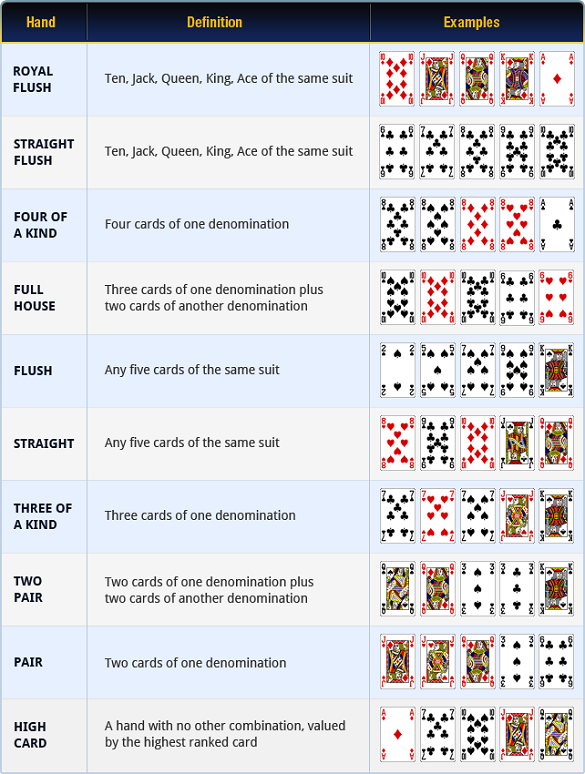
Standard poker hands, except for the ace-king, are valid in Texas hold'em. We are going to list them in descending order: a royal flush, straight flush, four of a kind, full house, flush, straight, three of a kind (tris), two pairs, pair, and high card.
Comparison of Hands
Only five cards take part in the formation of a hand. Values of other cards are irrelevant. For example, 4, 5, 6, 7, 10 are in the flop, and the players have an 8 and 4, and an 8 and J. It is a draw.
Suits of cards are not taken into account during the comparison.
If the five highest-ranking cards that form a hand are common for players, a draw is announced. For example, 2, 2, 2, 2, A are in the flop, and players have a 10 and 9, and a 6 and 5.
A draw is also announced if the highest-ranking hand is formed from community cards, and high cards of players that are included in it are equal. For example, 2, 2, 3, 3, 6 are in the flop, and players have a 10 and 8, and a 10 and 6.
The comparison of hands of the same rank (pair, three of a kind, straight, etc.) takes place according to generally adopted poker rules.
Types of Bets
- Small blind is a bet that is equal to half the minimum bet determined by the table limit. It has to be made by the player who is sitting clockwise next to the dealer (the dealer button).
- Big blind is a bet that is equal to the minimum bet determined by the table limit. It has to be made by the player to the left of the small blind.
- Ante is a forced initial bet that is primarily made during tournaments. It is made by all players before each deal.
Gameplay
A special marker called button, which determines the dealer in each individual round, is used in Texas hold'em. If the croupier does not participate in the game, this player deals the cards. The player who is sitting next to him clockwise must make a small blind before the beginning of the deal, and the next player wagers a big blind.
- Pre-flop. As soon as the blinds are made, players receive two pocket cards face down. Then the first round of betting starts. This round is called pre-flop. The first decision is made by the player next to the big blind. He or she may fold, call (make a bet equal to the big bland), or raise. If one of the players raises, his or her opponents may re-raise. The next stage of the game starts when all players call.
- Flop is a next stage that starts when three face-up cards are placed on the table. They are called flop. They are community cards that can be used to form hands. Then the second round of betting starts. The first decision is made by the player who is sitting next to the button. He can bet within the limits of a given table, fold, or check, i.e. he does not fold but delegates power to decide to the next player. If a player makes a bet, his opponents may fold, call, or raise. It is not allowed to check in this case. This round ends when all contestants call.
- Turn is a round in which another community card called turn is revealed. Betting occurs in the same way as in the previous round.
- River is the last community card, which is revealed in this round. Then the last round of betting starts.
- Showdown is a round when all players who are still in game reveal their cards. The winner is determined. He or she collects the entire pot. If hands of players are equal, they share the pot.
If only one player is left in any round, he or she becomes the owner of the pot.
Then the button is transferred to the next player clockwise, the new deal starts.
Versions
Casino Texas Holdem Poker Rules R Rules And Regulations
Texas Hold'em has several versions of rules that regulate the upper limits of bet sizes:
Texas Hold'em Poker Rules Raise
- Fixed limit is a certain bet size established for each round. Four stages of betting are available: bet, raise, re-raise, and cap (final raise).
- Pot limit. The minimum bet size can not be smaller that a big blind, and the maximum one should not exceed the pot size. A re-raise can not be smaller than the previous raise unless the player goes all-in. The number of rounds of betting is not limited.
- No-limit. The minimum bet size is equal to the big blind, and the maximum one is unlimited. A re-raise can not be smaller than the previous raise unless the player goes all-in. The number of rounds of betting is not limited.
- Mixed limit. The maximum bet size is limited only in some rounds.